
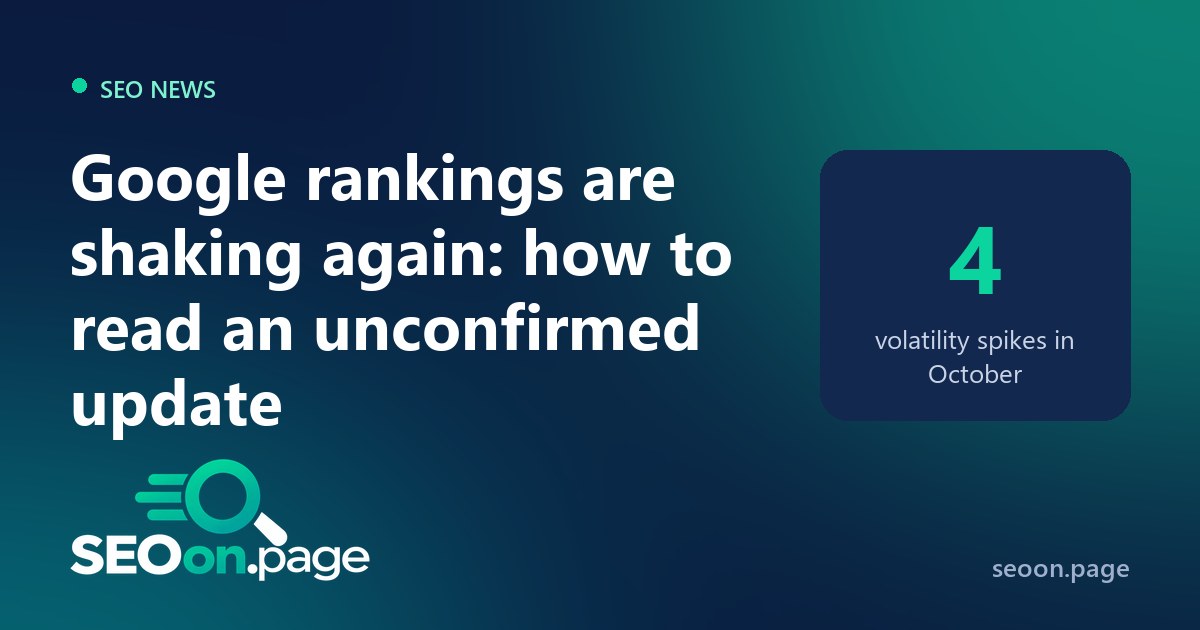
If your rankings moved a lot in late October 2026, you are not alone. Search Engine Roundtable reported several waves of volatility, and on October 27 the SEO community saw the biggest spike of the month. Google, however, has not confirmed any update. Here is what we know and how to react without guessing.
What happened
- October 16, October 20-21 and October 24: earlier waves of unconfirmed ranking changes, each followed by forum chatter.
- October 27: a larger spike in volatility and in community discussion, which appeared to start overnight. Semrush’s sensor was among the tools showing very high readings.
- No confirmation: Google’s Search Status Dashboard still lists the September 2026 spam update, which ran from September 24 to October 8, as the latest ranking update.
- Mixed reports: some publishers describe weak traffic from Google News and Discover, while other site owners report large keyword gains that have not yet turned into traffic.
Why the data is harder to trust this time
Third-party trackers are the main source of “update” signals, and this fall they have a problem of their own. Since around September 20, part of the result pages Google returns to automated requests have been complete but incorrect, which we explained in poisoned SERPs and rank tracking. Search Console has also been slow: the page indexing report stopped updating for days in October. Read what Google says about that delay.
In practice, that means a spike in a sensor can be a real ranking change, a data problem or both. Treat any single chart with caution.
How to diagnose a traffic change
- Start with Search Console performance data. Compare clicks and impressions by page and query for the days before and after the change. It reflects real users, not scraped results.
- Check the date of the data. Search Console reports show when they were last updated. Do not draw conclusions from a report that is several days behind.
- Rule out technical causes first. Server errors, accidental noindex tags, robots.txt changes and broken redirects look like algorithm hits. Check key URLs with our HTTP Header Checker and Redirect Checker.
- Look at patterns, not single keywords. A drop across a whole section or page type tells you more than one keyword moving ten positions.
- Separate Search, Discover and News. They have different systems and can move independently.
- Wait before rewriting. Unconfirmed changes often partly reverse. Large edits in the middle of volatility make it harder to know what worked.
What to do if Google confirms a core update
If Google announces a core update, the advice stays the same: wait until it finishes, compare performance before and after, and review the affected pages for helpfulness and quality rather than chasing quick fixes. Choose a tracker you trust, too: see our comparison of the best rank tracking tools.
Frequently asked questions
Frequently asked questions
Was there a Google update in October 2026?
Google has not confirmed one. Trackers and forums reported strong volatility on October 16, 20-21, 24 and 27, but the last confirmed ranking update is the September 2026 spam update.
Why do rank trackers show different results?
Each tool tracks different keywords and locations, and since September some automated requests receive incorrect results from Google, which can distort the data.
Should I change my content during volatility?
Usually not right away. Check for technical problems first and wait until rankings settle, so you can measure what actually changed.
Where can I see official Google updates?
On the Google Search Status Dashboard, which lists confirmed ranking updates with their start and end dates.