A common assumption in AI search is that if enough pages mention your brand, ChatGPT will mention it too when it searches the web. New data suggests it is not that simple. An analysis by the growth agency Graphite, published on October 16, 2026 and reported by Search Engine Journal, found that what the model already knows shapes what it says, even when it searches.
What the data shows
- Memory carries over into search. Graphite compared logged-out ChatGPT answers to comparison prompts with and without search, across 3,115 brand-question pairs on 57 questions. Brands that ChatGPT rarely named without search were also rarely named with search.
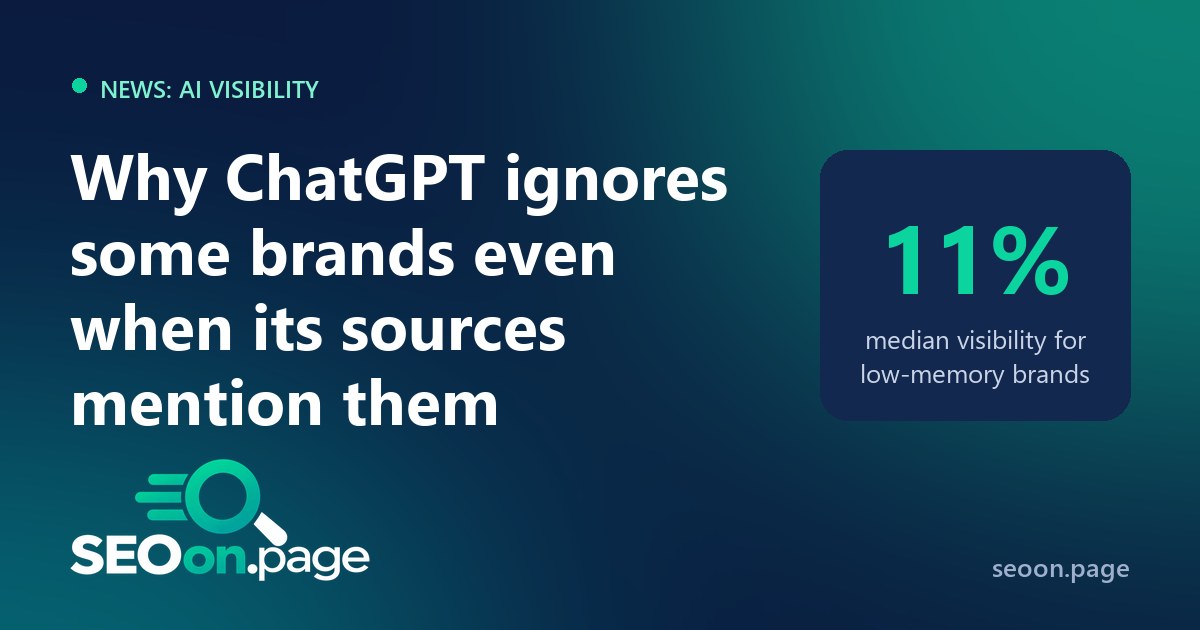
- Cited pages are not enough. Among brands mentioned on at least 15% of the pages ChatGPT cited, those named in under a quarter of no-search answers had a median visibility of just 11% when it searched.
- Brands appear in the hidden searches. In about 957,000 background search queries from 22,953 non-branded prompts, 59.6% contained a brand name the user never typed. ChatGPT appears to search for the brands it already has in mind.
- Citations are rising. The share of logged-out ChatGPT answers with citations rose from 56.6% in early August to 88.5% at the end of September 2026.
Read it with caution
- Correlation, not proof. The data does not control for brand awareness: well-known brands may simply be named more in every setting.
- Method gaps. Only one of the replications explicitly switched search on and off through the API, and AI labs do not disclose training data.
- Commercial interest. Graphite sells AI search optimization services, as Search Engine Journal points out.
What it means for your brand
- Being known matters more than being cited. If a model learned little about you in training, more mentions on the pages it reads today may not change its answers much. Long-term presence in trusted sources is what builds that memory.
- Expect a delay. Graphite estimates two to five months between a model’s knowledge cutoff and its release, the minimum time for new content to influence what it knows.
- Let training crawlers in, if you want to be known. Blocking GPTBot and similar bots keeps your content out of future training data. Check your settings with our AI Bot Checker, and remember that a CDN or firewall can block them too.
- Measure memory, not only search. Our free AI Visibility Checker asks a model what it knows about your brand from training data, which is exactly the factor this study points to. To track AI answers over time, compare the best AI visibility tools.
Frequently asked questions
Frequently asked questions
Why doesn’t ChatGPT mention my brand?
Often because the model learned little about it in training. Graphite’s data suggests brands rarely named from memory are also rarely named when ChatGPT searches, even if cited pages mention them.
Does getting mentioned on more websites help?
Over time, yes, because it can shape future training data. In the short term, more mentions on cited pages did not reliably increase brand mentions in Graphite’s data.
Should I block GPTBot?
Only if you prefer to keep your content out of OpenAI’s training data. Blocking it can reduce how well future models know your brand.
How can I see what ChatGPT knows about my brand?
Ask it without search, or use a tool such as our AI Visibility Checker, which asks an OpenAI model what it knows from training data.